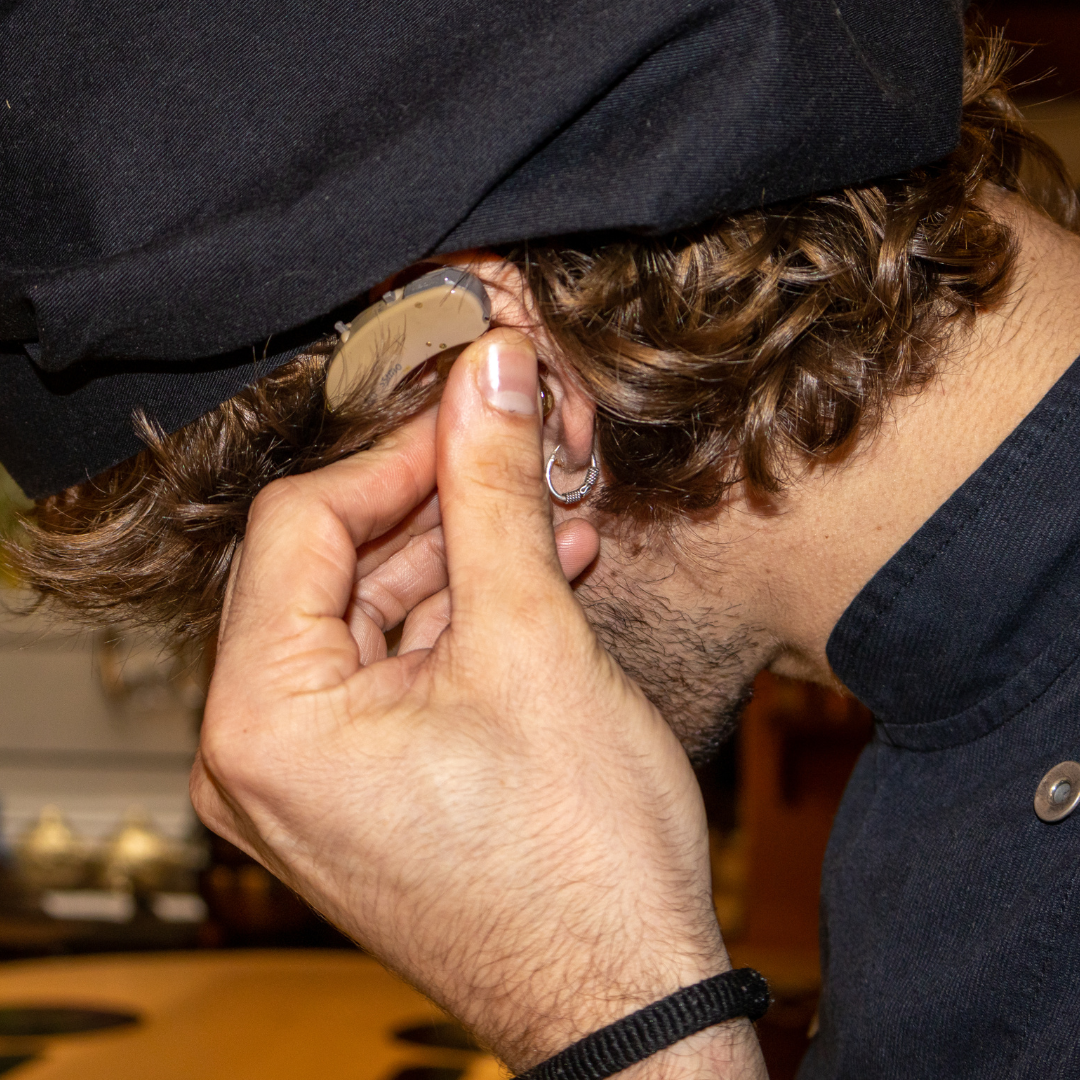
Tracking speech in busy dining venues can feel exhausting when environmental noise drowns out your hearing. Our audiology clinic conducts specialized testing to evaluate hearing in both quiet sound booths and noisy simulations to isolate the underlying cause. After uncovering the precise factors driving your difficult hearing, our team helps you select individualized auditory solutions.
Why Everyday Hearing Fails in Busy, Noisy Restaurants
A quiet setting creates an optimal signal-to-noise ratio, ensuring the conversational partner’s voice rises cleanly above ambient sounds. Modern restaurant environments create the complete opposite listening environment. Layered diner voices, kitchen activity, foreground music, and room reverberation muddy speech signals, requiring intense mental strain to follow dialogue.
This problem can occur with high-frequency hearing loss, auditory-processing difficulty, or age- and noise-related changes. Factors including listening fatigue, poor dining lighting, acoustic distance, and wandering attention make comprehension significantly harder. Some people have normal results on a basic hearing test but still perform poorly on speech-in-noise testing. Consistent difficulty following restaurant conversation warrants clinical investigation even when everyday hearing seems largely unaffected.
The Audiological Process for High-Frequency Hearing Loss
The diagnostic workup opens with an extensive intake examining difficult listening environments, past noise trauma, tinnitus presence, family history, and medical history.
Pure-tone audiometric evaluations measure the absolute quietest sounds audible across specific octave frequencies using air and bone conduction. High-frequency loss often creates an audiogram pattern in which thresholds become poorer as pitches rise. Further clinical diagnostics feature tympanometry to evaluate eardrum and middle-ear mechanics as well as word-recognition testing for speech comprehension.
Because testing in a silent booth does not mirror real-life restaurant environments, speech-in-noise testing supplies vital diagnostic clarity. It evaluates sentence-level speech comprehension as competing background babble increases in volume. Interpreted together, these clinical scores demonstrate whether listening struggles originate from loss of audibility, speech clarity deficits, auditory processing delays, or combined elements.
Auditory Processing Disorders: Impact on Adult Communication
A diagnosed auditory processing disorder affects how the brain’s auditory cortex analyzes, organizes, and interprets sound. A patient’s ears may demonstrate normal pure-tone sensitivity, but their central processing system struggles to separate background babble, distinguish consonant sounds, or follow swift discussions. We systematically verify peripheral hearing health before establishing whether an advanced auditory-processing evaluation or medical referral serves your needs.
Practical Strategies for Improving Speech Understanding in Noise
Small changes can improve the signal reaching your ears and provide clearer visual cues. When planning to dine out, select restaurants with calmer atmospheres or arrange reservations during off-peak hours. Establishments designed with high-walled booths, acoustic wall treatments, heavy fabrics, and carpeting reduce reverberation far better than modern industrial spaces with bare surfaces.
At the restaurant:
- Ask host staff for a quiet table distanced from kitchen traffic, bar noise, audio speakers, and loud group tables.
- Position yourself with your back toward a solid partition to dampen intrusive background noise from behind.
- Face your conversation partners in good lighting.
- Maintain the shortest comfortable physical distance between yourself and your conversation partner.
- Place your better-hearing ear toward the person you most want to hear.
- Prompt companions to rephrase unclear sentences with alternate terminology instead of repeating identical words.
- Clarify critical details explicitly instead of nodding along or pretending to catch the message.
- Step away for a brief auditory rest when cognitive listening fatigue begins to set in.
- Ask companions to speak clearly at a natural pace.
- Shouting creates acoustic distortion that actively compromises speech understanding rather than helping.
Assistive Listening Technologies for Noisy Environments
Choosing the most effective auditory device requires evaluating diagnostic findings, acoustic lifestyle factors, and the presence of hearing loss. Customized hearing aids employ directional microphone beamforming, noise cancellation algorithms, and targeted dining programs to prioritize speakers in front while lowering ambient noise. Patients must uphold realistic expectations because modern amplification cannot strip out every ambient human voice completely.
Utilizing an external remote microphone can deliver a dramatically superior signal-to-noise ratio. Positioned near or clipped to the speaker, the device transmits raw speech audio directly to paired hearing aids or external listening receivers. Direct audio routing minimizes the acoustic penalty of conversational distance and surrounding environmental din.
Other useful options include:
- Omnidirectional table microphones designed for group dining tables
- Hearing-loop telecoils that stream clean audio in loop-equipped establishments
- Smartphone speech-to-text or live-captioning applications
- Smart earbuds offering dedicated speech-in-noise amplification settings
- Decibel-level applications and restaurant rating guides for finding quiet tables
Our audiology staff helps you evaluate options, ensures wireless compatibility, and trains you on operating your chosen equipment.
The Clinical Role of Audiologists in Managing Loud Environments
Undergoing a formal hearing evaluation takes your care beyond the limited baseline of hearing adequately in quiet spaces. We can review the places, speakers, and noise levels that cause problems and select tests that reflect those concerns. The diagnostic battery may encompass pure-tone thresholds, acoustic middle-ear evaluations, suprathreshold word recognition, and speech-in-noise measures. Auditory-processing testing may be considered when the history and initial results support it.
Rapidly progressing, asymmetrical, or sudden hearing decline warrants an urgent clinical referral to an ear, nose, and throat physician. Personalized patient care establishes the true medical source of your listening problems instead of assuming ambient noise is solely responsible.
Request an Audiology and Hearing Evaluation Today
When dining out causes you to guess at words, detach from family, or experience severe listening exhaustion, book a comprehensive hearing evaluation with us. We can explore ways to help with hearing in noisy environments with hearing-aid adjustments, assistive tools, or rehabilitation options that may fit your needs.
Contact our audiology office today to schedule your evaluation and move toward effortless, confident conversations.